
Navigating the media landscape in the Middle East requires more than just a compelling story. It demands a deep understanding of sectoral nuances, local audience expectations, and the evolving regulatory frameworks that govern how corporate messages are shared.
To help businesses effectively communicate across the region, we are sharing a series of industry-specific communications guides. Last week we tackled Fintech, this week – HealthTech
When healthcare executives, clinical directors, and hospital procurement boards face rapid industry transitions or regulatory shifts, their primary driver is not curiosity about technical software specifications. They are managing clinical risk, protecting patient data, justifying substantial investments, and looking for a specific return on investment.
Standard corporate boilerplate and dense technical feature lists fail during these high-stakes moments because they do not address underlying operational and compliance anxiety. For healthtech founders looking to connect with non-technical healthcare stakeholders, the solution lies in treating communication as a leadership tool that anchors clinical trust across every public platform, from corporate press announcements to editorial content.
Leadership as a Service
Hospital and clinic decision-makers rarely buy digital solutions purely based on architectural data sheets. They invest in the team capable of guiding them through deployment, integration with existing electronic medical records, and complex compliance frameworks. Healthtech founders can use their entire communications ecosystem—including press interviews, thought leadership articles, and public announcements—to provide this exact context and reassurance, establishing a form of leadership as a service.
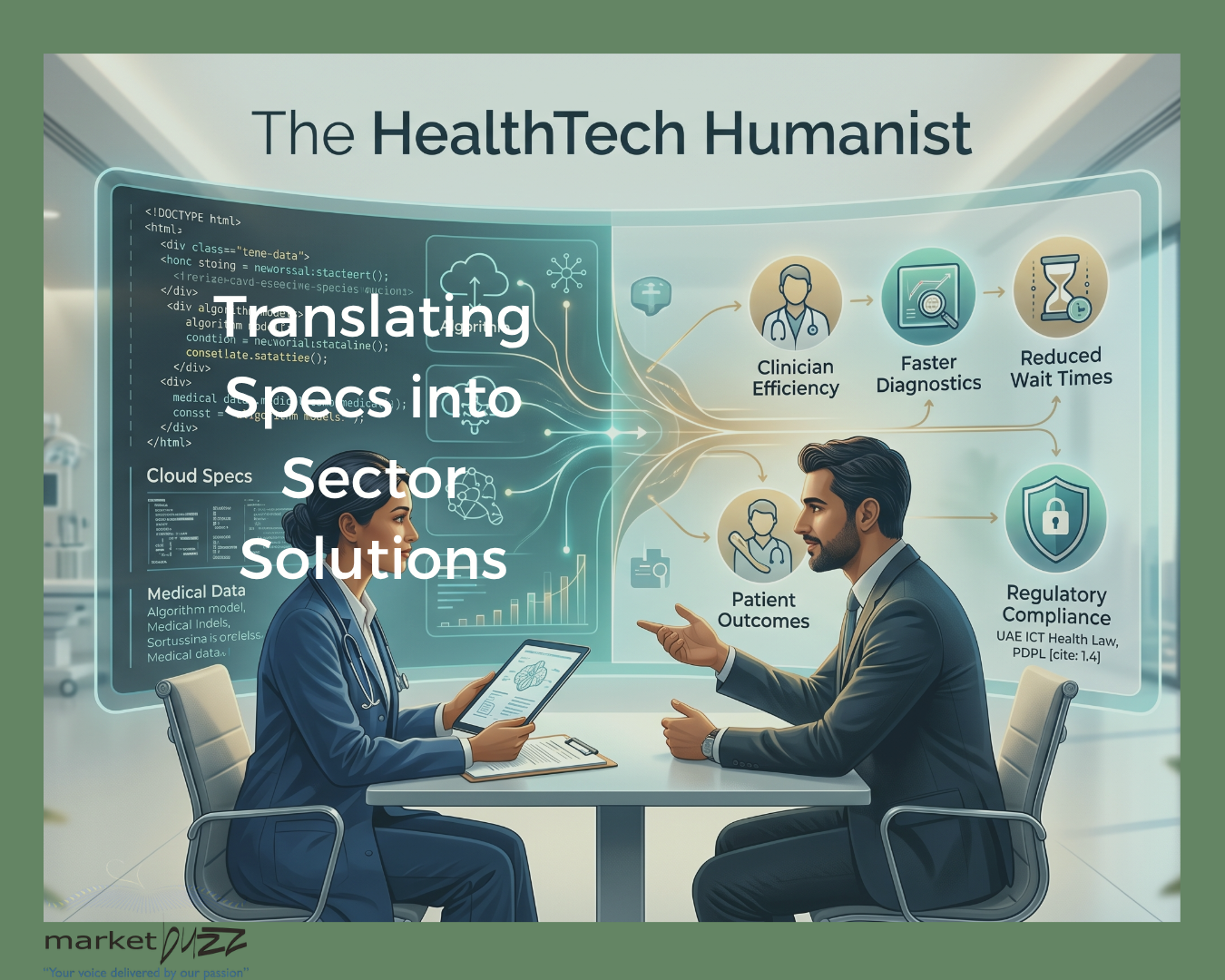
Instead of breaking down algorithm models or cloud architecture, focus on the broader operational and patient care impact. Frame your insights around how the technology reduces clinician burnout, shortens patient wait times, or minimizes diagnostic errors. When a founder provides a clear roadmap of where regional healthcare delivery is heading, non-technical buyers find the clarity they need to make high-stakes purchasing decisions.
Navigating the Regulatory Narrative
In the Middle East, trust is heavily tied to regulatory alignment. Founders cannot communicate in a vacuum; their messaging must reflect the strict legal frameworks governing the region across all official statements and corporate channels.
Within the UAE, communications must respect the multi-layered regulatory environment across federal and emirate levels. Key pillars such as Federal Law No. 2 of 2019 (the ICT Health Law) place strict mandates on data localization, ensuring health data is stored, processed, and hosted on servers within the country. Furthermore, the UAE Personal Data Protection Law (Federal Decree-Law No. 45 of 2021) treats health data as highly sensitive, requiring enhanced protection protocols and explicit consent.
In Saudi Arabia, the Personal Data Protection Law (PDPL) imposes parallel restrictions on cross-border data transfers, while the Saudi Food and Drug Authority (SFDA) enforces rigorous oversight on Software as a Medical Device (SaMD).
When healthtech founders release announcements or write commentary, ignoring these compliance realities makes a brand appear disconnected. Addressing how a solution natively aligns with these parameters demonstrates that the company respects the regional rulebook and prioritizes systemic security.
Audit HealthTech Communications
To ensure executive commentary, media pitches, and public updates remain grounded, compliant, and highly relevant during rapid market adjustments, founders should run a quick audit on all drafted communications before distribution.
- The Fluff Test: Remove introductory phrases that delay the main point. If an announcement relies on vague adjectives to describe a tool, replace them with a specific healthcare outcome or workflow improvement.
- The Clinical Translation: Scan for internal engineering terminology in press releases and articles. If a term describes how a backend algorithm works rather than what it achieves for patient care or administrative efficiency, translate it into operational terms like clinical accuracy, risk mitigation, or hours saved per shift.
- The Compliance Check: Evaluate whether a blog post or media response makes overreaching claims about data handling or diagnostic capabilities. Shifting the message to emphasize strict alignment with regional data localization and local healthcare authority standards ensures the content remains constructive, lawful, and practical.
Compliance as a Core Trust Driver
A distinct shift is occurring in how B2B healthcare buyers evaluate technology vendors. Recent research on sector communications highlights that compliance has evolved from a legal box-checking exercise into a primary marketing and trust differentiator. Enterprise buyers are increasingly relying on authoritative insights from company leadership to validate vendors before initiating direct procurement conversations.
According to industry data compiled by Onclusive’s PR Trends Analysis, establishing clear brand authority and stakeholder trust is a top strategic priority for over half of communications teams globally. For healthtech founders, this means ensuring that personal commentary, formal statements, and media relations consistently reflect sector challenges, patient privacy, and regional regulatory compliance to build long-term buyer confidence.
Keep Messaging Outcomes-Centric
For healthtech enterprises in the Middle East, a successful media relations approach requires moving away from feature-heavy product launch announcements. Journalists across the region are looking for stories that impact the local community, healthcare delivery, and national wellness goals, not product manuals disguised as news.
When preparing your next media pitch, corporate announcement, or editorial submission, structure the narrative around the sector or patient challenge first. Introduce your executive as the guide who understands the clinical or operational bottleneck, and position the technology as the practical mechanism used to solve it. Shifting the focus from what the software is to what the software secures for the healthcare ecosystem is the most direct path to earning meaningful media visibility.
Next in our series: Navigating Regional ESG Mandates.