
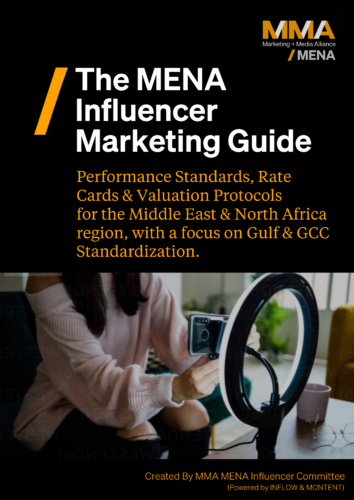
 The Marketing + Media Alliance MENA (MMA MENA) today published The MENA Influencer Marketing Guide, the first standardized framework for influencer performance measurement, valuation, and pricing across the Middle East and North Africa. Powered by Inflow and Montent, the guide is the inaugural output of the MMA MENA Influencer Marketing Committee and marks a significant step in MMA MENA’s ongoing commitment to elevating marketing standards across the region.
As the region’s leading marketing industry body, MMA MENA brings together senior practitioners from brands, agencies, and technology companies through a network of specialist committees focused on specific areas of marketing practice. Unlike working groups that stop at discussion, these committees are designed to produce practical outputs that the wider industry can adopt. The MENA Influencer Marketing Guide is the first such output from the Influencer Marketing Committee, and a demonstration of what this model of expert-led collaboration can deliver.
The GCC influencer marketing market is currently valued at approximately $315.5 million and is projected to reach $771.6 million by 2032. Yet despite this scale, the industry has long operated without consistent standards for how influencer campaigns are priced, measured, or evaluated. Pricing has been driven by follower counts and subjective negotiation rather than performance data, creating inefficiency for brands and inconsistency for creators. The guide addresses this directly, introducing a unified regional rate card, platform-specific performance benchmarks, and a proprietary valuation model built for the dynamics of MENA markets.
Central to the guide is the “Track the Power” valuation methodology, which calculates a creator’s financial value using an Impact Score that combines content category, engagement rate, and creator authority. An accompanying Influencer Budget Calculator translates this model into a practical tool, allowing brands and agencies to input campaign parameters and receive a recommended budget range and projected return on investment. The guide also documents the regulatory environment shaping the industry across the GCC, including licensing requirements in both the UAE and Saudi Arabia.
The scale of the opportunity the guide seeks to help the industry capture is significant. In the Middle East, 78% of consumers discover new brands through social media, and 60% report purchasing a product based solely on an influencer’s recommendation, both figures well above the global average. Micro-influencers now account for 45% of GCC market share, reflecting a broader regional shift toward trust and relevance over reach alone.
“The MENA influencer market is one of the most dynamic in the world, yet it has operated without the benchmarks that marketers rely on in every other channel. This guide gives the industry a shared language and a data-driven foundation to evaluate, negotiate, and report on influencer investment with confidence.” – Juanes Lopez Bedoya, INFLOW, on behalf of the MMA MENA Influencer Marketing Committee
“MMA MENA’s committees are where industry expertise becomes industry progress. The Influencer Marketing Committee brought together some of the sharpest minds working in this space across the region, and this guide is the result of that collaboration. Our goal has always been to give the industry something genuinely useful: standards it can adopt, benchmarks it can measure against, and a framework that works in the real conditions of MENA markets. This is the first of what we expect to be many such outputs.” – Linda Kender, Regional Director, MMA MENA
The MENA Influencer Marketing Guide is available to MMA MENA members and the wider industry. For access, visit https://mmaglobal.com/documents/mma-influencer-marketing-guide