
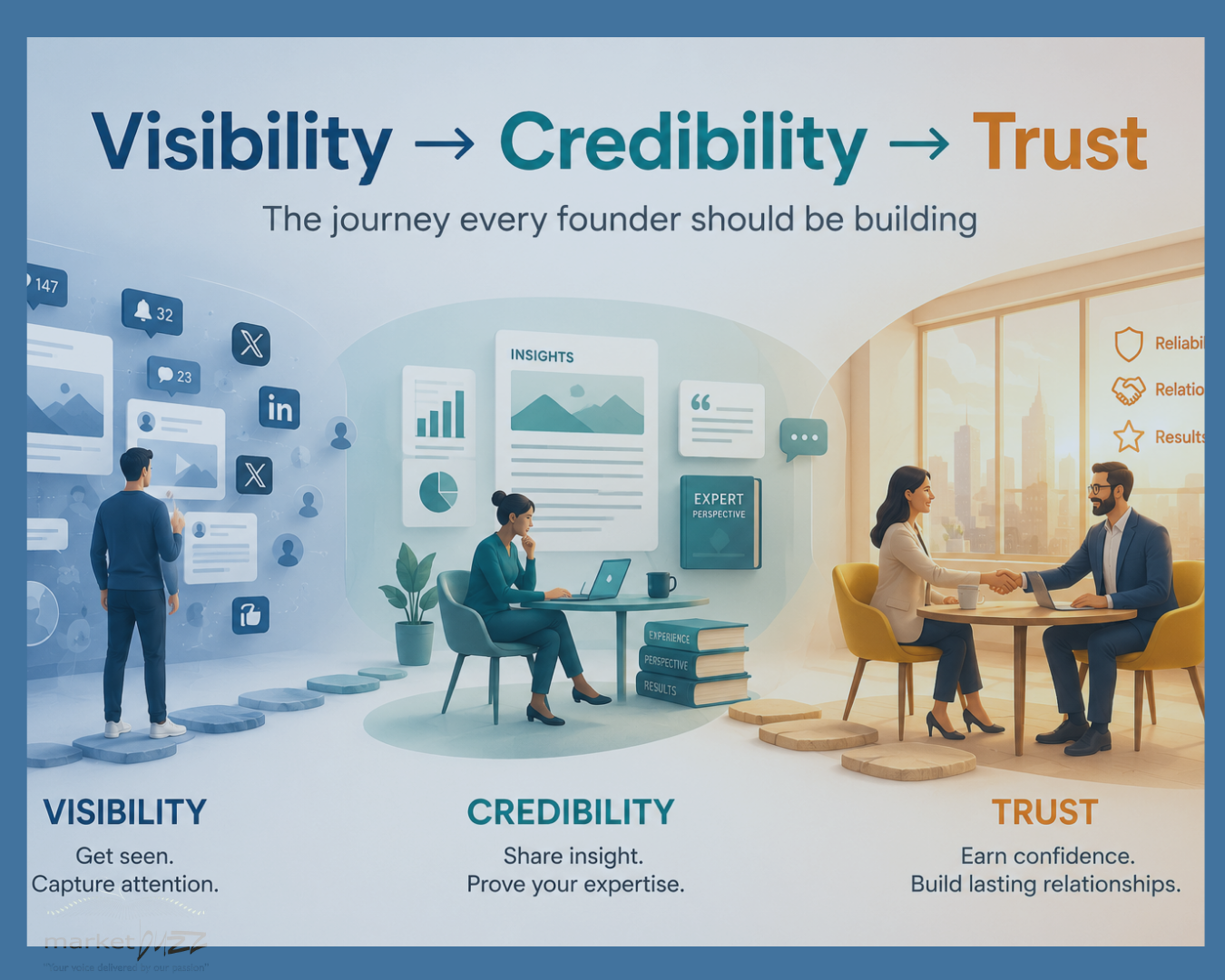
Being visible is not the same as being credible.
Plenty of founders post often enough to stay in view, but that alone does not build the kind of confidence that makes people listen, remember, and take the next step.
That distinction matters more now because buyers increasingly assess businesses through the quality of what their leaders publish. The most recent Edelman-LinkedIn research found that 95% of hidden decision-makers say strong thought leadership makes them more receptive to sales and marketing outreach, which means content is not just a visibility tool; it is part of how trust is formed before a conversation even starts.
The difference between visibility, credibility, and trust
Visibility is about attention. It means your audience has seen your name, your brand, or your content.
Credibility is about belief. It develops when people begin to see that your perspective is informed, relevant, and grounded in real experience.
Trust is what builds over time when your content repeatedly proves that you understand the market, speak with clarity, and show up in a way that feels reliable. A founder can be visible without being credible, and credible without yet being trusted, but useful and consistent content helps move all three forward.
This is where many founder-led content strategies go wrong. Promotional posting may create awareness, but useful posting creates confidence because it gives people a reason to believe there is substance behind the visibility.
Three habits that make founder content believable
The first habit is consistency. One strong post can attract attention, but a steady pattern of thoughtful content tells your audience that your point of view is dependable rather than occasional.
The second habit is specificity. Generic motivation rarely carries much weight, but content that addresses a real client concern, a sector shift, or a lesson from direct experience feels more credible because it sounds observed rather than recycled.
The third habit is proof. When founders support their perspective with examples, results, lessons learned, or practical evidence, their content becomes easier to trust because it shows substance instead of assertion.
These habits matter because repetition only works when the message stays clear and is backed by something real. Audiences do not build trust from one polished post; they build it gradually from reliable signals delivered over time.
What audiences trust more
Founders often assume content works best when it promotes a launch, a milestone, or a service. Those updates have their place, but they are rarely the posts that make an audience feel confident in your judgment.
Credibility grows faster when founders comment on real client issues, changing market conditions, practical business lessons, or shifts in the sector that matter to their audience. This kind of content signals experience, perspective, and relevance, which are often far more persuasive than self-promotion.
The Edelman-LinkedIn report reinforces this point by focusing on hidden buyers, the people who may influence a purchase without ever entering a sales conversation directly. When these decision-makers are already evaluating a founder’s thinking through content, trust starts forming long before a proposal or meeting is on the table.
One weekly habit
One useful habit is to publish a single post each week that answers a real client question, comments on a relevant industry shift, or shares one business lesson with a clear takeaway. Done consistently, that small discipline helps move content away from occasional promotion and toward long-term trust building.
Before publishing your next post, review your last five and label each one as promotional, educational, or credibility-building. That quick audit is often enough to show whether your content is simply helping you stay visible or actually helping your audience believe you.
- Promotional: announcing, selling, or drawing attention to the business.
- Educational: explaining something useful, relevant, or timely.
- Credibility-building: showing perspective, experience, proof, or practical judgment.
If most of your recent content is promotional, your audience may know you are active without understanding why they should trust you. If more of it is educational or credibility-building, you are doing the slower but more valuable work of strengthening authority.
This does not mean every post needs data or a case study. It means each post should leave the audience with a clearer sense that you understand the issues they care about and have something worthwhile to say about them.