
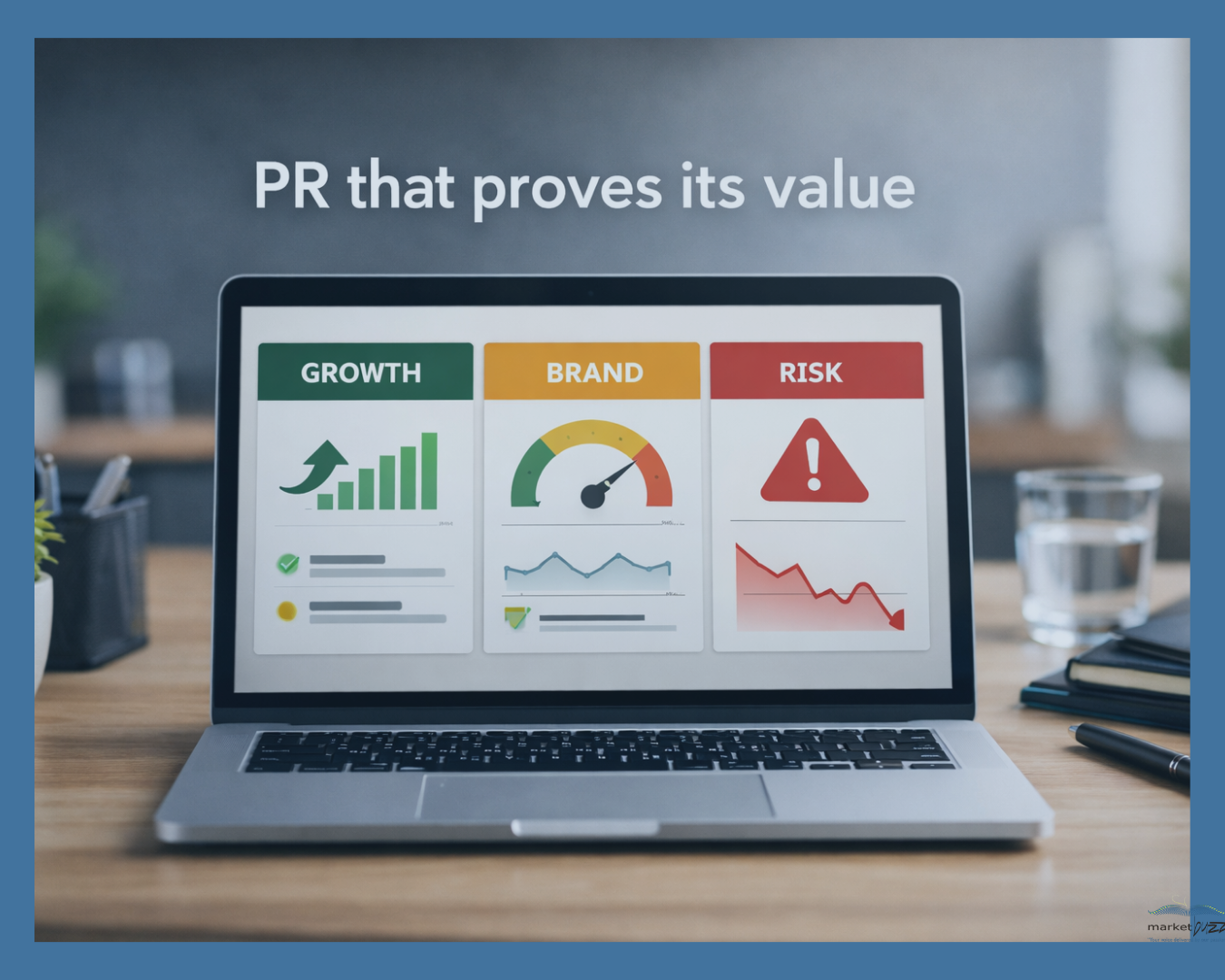
If you’ve ever presented a PR report full of reach and impressions and sensed it wasn’t landing, you’re not alone. Leadership isn’t uninterested in PR. They’re interested in outcomes: Growth. Risk. Reputation.
The 2026 outlook from Onclusive makes this clear. Measurement will make or break communications teams, and correlation models linking coverage to pipeline and revenue are becoming the benchmark. Activity without impact is no longer persuasive. PR teams must demonstrate commercial and reputational contribution in an AI shaped media landscape. Authority, credibility and integration matter more than volume.
Frameworks reinforce this shift, mapping a clear path from objectives to outputs to outcomes and ultimately organisational impact. If your reporting stops at coverage, it’s incomplete.
So what does a simple, leadership ready PR dashboard actually look like?
Start with business goals
Before choosing metrics, align with strategy. Market entry. Investor readiness. Regulatory trust.
As CallPM notes in its guide to measuring PR ROI, communications should be treated as a management discipline, using executive language such as growth and risk, not just media counts.
Four layers that matter to leadership
- Business impact
Even at SME level, you can track contribution.
- PR influenced website sessions
- Leads or enquiries referencing coverage
- Pipeline value where PR was an assisting touch
Recent ROI discussions from Influencers Time and PRSA stress linking PR to pipeline and cost efficiency, not claiming full credit but showing influence.
https://www.influencers-time.com/measuring-pr-roi-for-business-growth-in-2025/
https://www.prsa.org/article/5-ways-to-measure-pr-performance-value-and-roi
- Brand and reputation health
Research on metrics that matter recommends focusing on share of voice, sentiment trends and message pull through rather than raw volume. In the GCC context, where reputation often drives opportunity, this layer is critical.
- Authority and strategic exposure
Muck Rack highlights that executive visibility, bylines, high authority placements and credible backlinks are increasingly important signals, particularly in the AI search era. Authority now influences both human perception and generative discovery.
- Risk and resilience
Boards want to know how exposed they are.
Track:
- Spikes in negative sentiment
- Emerging issue trends
- Time to detect and respond in a crisis
- Monitoring and response speed are now core leadership metrics, not optional extras.
What to remove
- Reach, impressions and clip counts can sit in a small diagnostic panel. They should not dominate.
- Advertising Value Equivalents are widely rejected and should not appear in executive dashboards, a position reinforced by AMEC and ICCO guidance.
Keep the structure simple.
Leadership research on KPI dashboards suggests a small, consistent set of indicators answering three questions:
Are we supporting growth?
Are we strengthening brand and authority?
Are we managing risk?
A one page dashboard might include:
Top line:
- PR influenced pipeline
- Brand strength index
- Risk indicator
Supporting layer:
- Share of voice by priority market
- Sentiment trend
- Executive visibility
Plus short commentary on what changed and what action is recommended.
The shift is clear. PR dashboards in 2026 must prove contribution, not just activity.
If you’re running an SME in the Middle East, ask yourself: can your current PR report show growth influence, authority and risk management in one page?
If not, it’s time to simplify and sharpen it.