
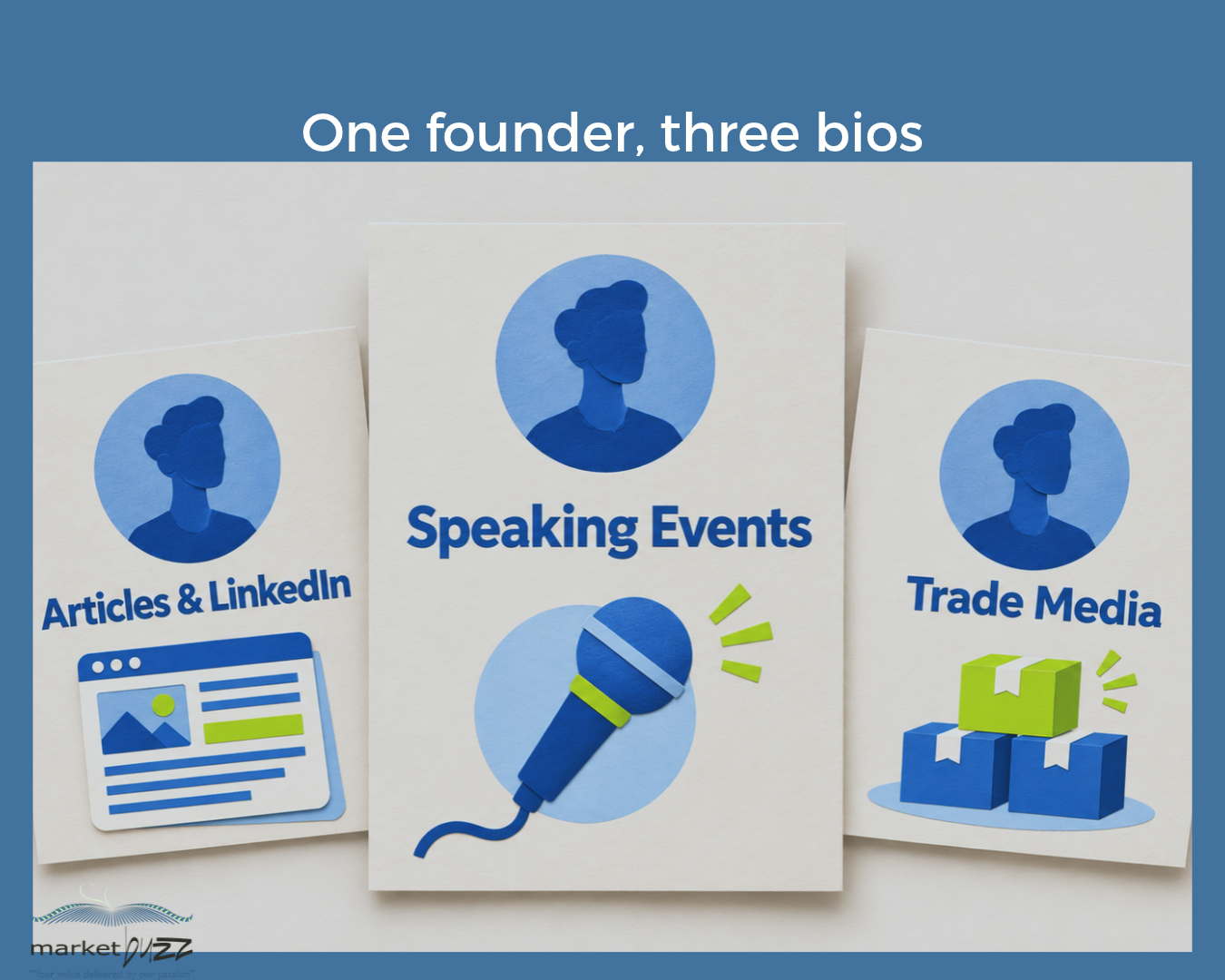
A journalist is writing about why small retailers in the UAE have so much cash tied up in stock. She opens a founder’s bio and learns that the founder runs a company that helps retailers manage inventory. The detail that would make her pick up the phone is missing. Before starting the business, the founder spent ten years deciding what to reorder, what to discount and what to leave on the shelf.
It’s easy to slip into pitching your business when someone asks for your bio. Give the company a sentence of context, then put the focus back on you. What have you done firsthand? What decisions have you had to make? What could you help someone understand? If most of the bio could sit on your company’s services page, make room for more of your own experience.
A short bio for articles and LinkedIn
Start with two or three sentences you can send with a contributed article or adapt for the opening of your LinkedIn About section. Include your current role, one detail that shows what you’ve done and the area you know best. Write it in the third person for an article. On LinkedIn, use the first person so it sounds like you.
For example, a retail founder might write, “I spent ten years managing stock for UAE retailers before starting my business. I now work with independent shop owners on what to buy, when to reorder and how much cash to keep free for the next season.”
A longer bio for speaking opportunities
A conference organiser needs to picture what you’d bring to a session. Add a relevant project, what you were responsible for and what the audience could learn from it. If you’ve spoken on the subject before, include a link to a talk or panel.
Give the organiser a couple of specific topics to work with. “How independent retailers can plan stock for Ramadan” gives them a clearer idea of the session than “retail trends”. Ohio State University makes a similar point in its advice to experts writing media bios. Keep it brief and make it easy to see which topics you can speak about.
Check the application form before you send your bio. Intersec Dubai asks for 100 to 200 words, while Dubai FinTech Summit asks for both a short profile under 500 characters and a full professional bio. Keeping both versions ready gives you time to choose the experience that matters most to that audience.
A bio that speaks to your sector
If you’re building a profile in a specific sector, bring your most relevant experience into the first few lines. For a grocery trade publication, the retail founder might lead with what she’s learnt about keeping shelves stocked while reducing waste. For a general business publication, she might lead with how buying decisions affect cash flow.
Think about which example you’d bring up in the first five minutes of the interview. That’s often the one to put in the bio.
Give people a photograph they can use
Keep a recent, high-resolution portrait alongside your bios. Dubai FinTech Summit, for example, asks for an upper-body photograph in JPEG or PNG format, with the head and torso in frame and a file size of up to 5 MB. A wider shot can also give an editor more room to crop for an article.
Save the photos as separate downloads within your media kit, include any required credit and check that you have permission to share them for media and event use. Open the link on your phone to make sure someone outside the business can download them without requesting access.
Try a ten-minute edit
Open your current bio and highlight every sentence that tells the reader something specific about your experience. Add one thing you’ve done firsthand and one question you could answer from experience. Use those details to write the short version first. Then build out the speaker and sector versions with the examples each reader needs, and put the photo link beside them so everything’s ready to send.