
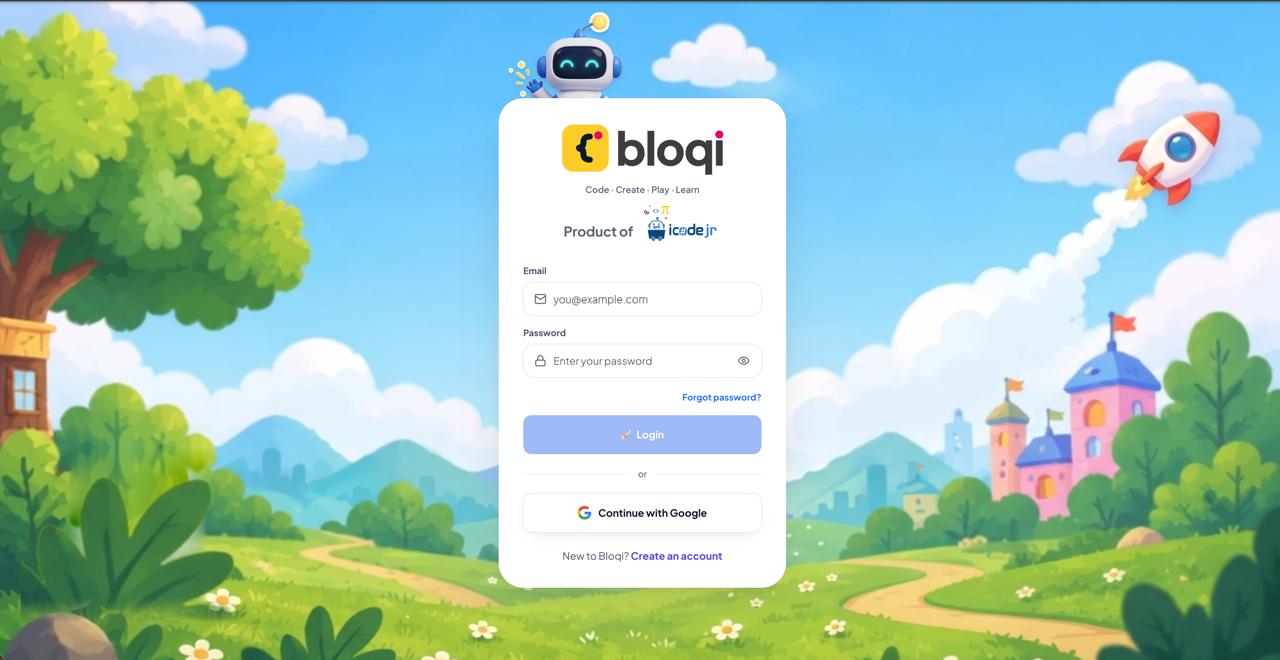
 iCodejr, the UAE-based digital and AI literacy academy for school children, has launched Bloqi, a new B2B platform that allows schools to teach coding, artificial intelligence (AI) and robotics through one bilingual learning environment. Available for the 2026-27 academic year, Bloqi supports a continuous learning pathway from ages four to 18 and is designed for delivery by non-specialist teachers.
Instead of requiring separate products for early-years block coding, text-based programming, robotics and AI, Bloqi gives schools one annual per-student-per-site licence, one teacher experience and one student account. English and Arabic are built into the platform throughout, rather than added through a translation layer. The browser-based system can also work offline.
Younger children begin with picture blocks before moving into fuller block-based coding and visual programming. Older students progress to an AI and machine learning sandbox where they train, test and examine their own models. A connected robotics interface allows students to control compatible hardware without installing separate software.
Hannan Moti, Co-Founder and CEO of iCodejr, said: “Schools know their students need to understand AI, but many do not have a computer science specialist or the confidence that a tool they buy today will still meet their needs in three years. Bloqi gives them one system that can grow with the student and is designed so that a non-specialist teacher can begin delivering lessons quickly.”
The platform was classroom-validated with a founding design partner before release, allowing iCodejr to test its interfaces and learning progression with children and teachers in a working school environment. It is aligned to the UAE national AI curriculum.
A shift from using to understanding AI
The launch of Bloqi comes as AI literacy moves into mainstream education. The UAE introduced AI as a formal subject in public schools from kindergarten to Grade 12 in the 2025-26 academic year. According to UNESCO’s overview of AI education in the UAE, the curriculum extends beyond the use of digital tools to include data and algorithms, ethics, real-world applications and the design and evaluation of AI systems.
The UNESCO AI Competency Framework for Students similarly describes young people as responsible users and co-creators of AI. Its progression moves from understanding to applying and creating, with AI system design included alongside ethics, techniques and applications. UNESCO’s framework for teachers highlights the need for practical competencies in AI foundations, pedagogy and responsible use, while acknowledging that many educators still lack clear guidance and training.
Bloqi’s approach reflects this shift. Rather than limiting AI education to prompting a chatbot, students work with the components behind AI and machine learning. They can build datasets, train models, test results and learn why systems behave as they do.
Moti added: “Teaching a child to prompt a chatbot is not the same as teaching them AI. Students need the chance to build, test and question the technology. When they train a model themselves, they begin to understand the relationship between data, decisions and outcomes, including where bias and errors can enter the process.”
One system across the school journey
Bloqi has four connected interfaces covering early-years block coding, a visual Block IDE for middle years, an AI and machine learning sandbox for older students, and browser-based robotics across the age range. Because the interfaces share the same engine, students do not have to start again with a new system as they move through different stages of learning.
“Bloqi came out of classrooms, not a lab,” Moti said. “Every design decision traces back to something that was not working for a child or teacher in a real lesson. Schools should not need to assemble several products simply to offer a coherent computing programme.”
The need for a stronger foundation in technology is also reflected in the World Economic Forum’s Future of Jobs Report 2025. The report identifies AI and big data, networks and cybersecurity, and technological literacy as the three fastest-growing areas of skills demand through 2030. Bloqi is designed to help schools build that foundation progressively, without changing systems as students move through different age groups.
Schools can learn more about Bloqi and request information at https://bloqi.icodejr.com