
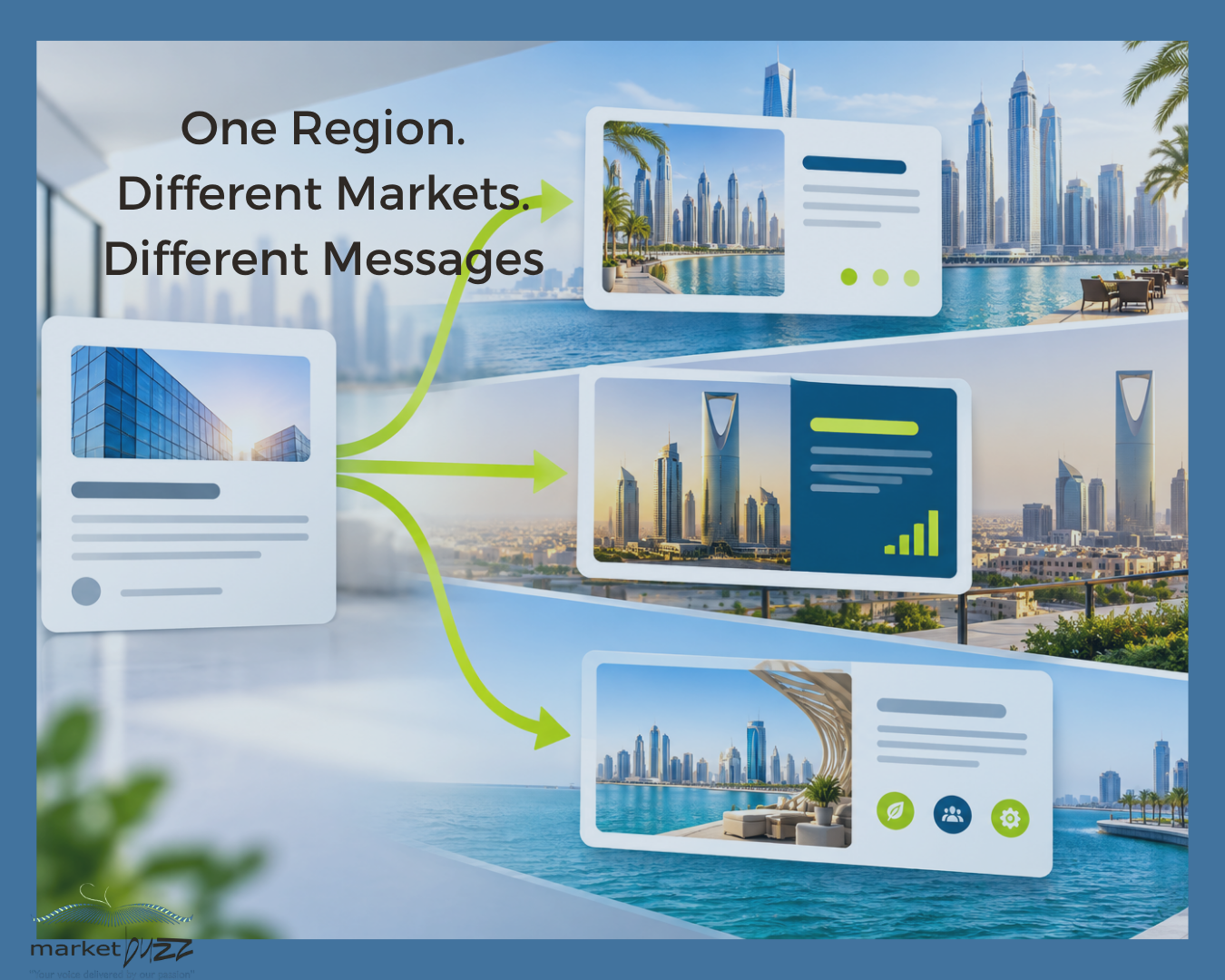
A company launches a new service across the GCC. The team prepares one announcement, translates it into Arabic and sends it to the same type of media in every country.
On paper, that looks efficient. In practice, it often produces disappointing results.
The GCC may be connected by language, geography and strong commercial ties, but it is not one market. The same announcement can carry very different weight in the UAE, Saudi Arabia, Kuwait, Qatar, Bahrain or Oman.
Localisation is not simply about changing the language. It is about giving each audience a reason to care.
Start with one announcement
Imagine a business technology company is launching a digital platform to help small businesses manage payments, customer records and business administration. The basic facts remain the same across the region. What should change is how those facts are presented.
In the UAE, the strongest angle may be convenience and integration. Businesses operate in a fast-moving, highly international environment, so the announcement might focus on saving time, connecting different systems and supporting companies with multicultural teams or customers. The proof could include a UAE pilot customer, data showing how much administrative time the platform saves, or a partnership with a locally recognised organisation. A UAE-based executive or customer may also be more relevant to the media than a spokesperson at global headquarters.
In Saudi Arabia, the story may need a different emphasis. Journalists and customers may want to understand the company’s commitment to the Kingdom. Is there a local office, Saudi partner or implementation team? Does the platform support Arabic properly? Is the company creating jobs, developing local skills or contributing to the growth of Saudi businesses? A broad statement about “supporting digital transformation across the Middle East” is unlikely to be enough. The Saudi version needs specific evidence of what the business is doing in Saudi Arabia.
In the smaller Gulf markets, the announcement may need to become even more focused. A regional expansion story may have limited relevance unless there is a local customer, distributor, partner or clear benefit for that market. Sometimes a short, tailored pitch to selected business or trade journalists will work better than distributing a full press release.
Change more than the country name
As we discussed in our earlier post on why localisation matters in a changing Gulf, audiences respond to information that reflects their own priorities and context.
For each market, review six elements.
- The language should sound natural, not translated word for word. Even where English is widely used, an Arabic version may help local media and stakeholders. The terminology may need to change too.
- The context should explain why the announcement matters in that country now.
- The evidence should be local wherever possible. Use relevant customers, partnerships, investment figures or results rather than relying only on global statistics.
- The media target should reflect the story. Business, technology, trade and Arabic-language outlets will not all want the same angle.
- The spokesperson should have credibility in the market. A regional CEO may suit a strategic business story, while a country manager, local partner or customer may provide more useful detail.
- The regulatory review must also be market-specific. Claims about data, pricing, health, finance, education or sustainability may require different checks. For example, the UAE and Saudi Arabia have their own personal data protection frameworks. The UAE Government’s guidance on data protection laws is a useful reminder that regional communications still need to meet national requirements.
Build one core story, then create local versions
This does not mean starting again for every country. Create a central message containing the facts that must remain consistent. Then prepare a short market brief covering the local angle, supporting evidence, spokesperson, target media, language requirements, timing and approvals.
Before releasing the story, ask one simple question: what gives someone in this market a reason to pay attention?
Translation changes the words. Localisation changes the relevance.
That is what gives an announcement a better chance of being understood, trusted and used across the GCC.