
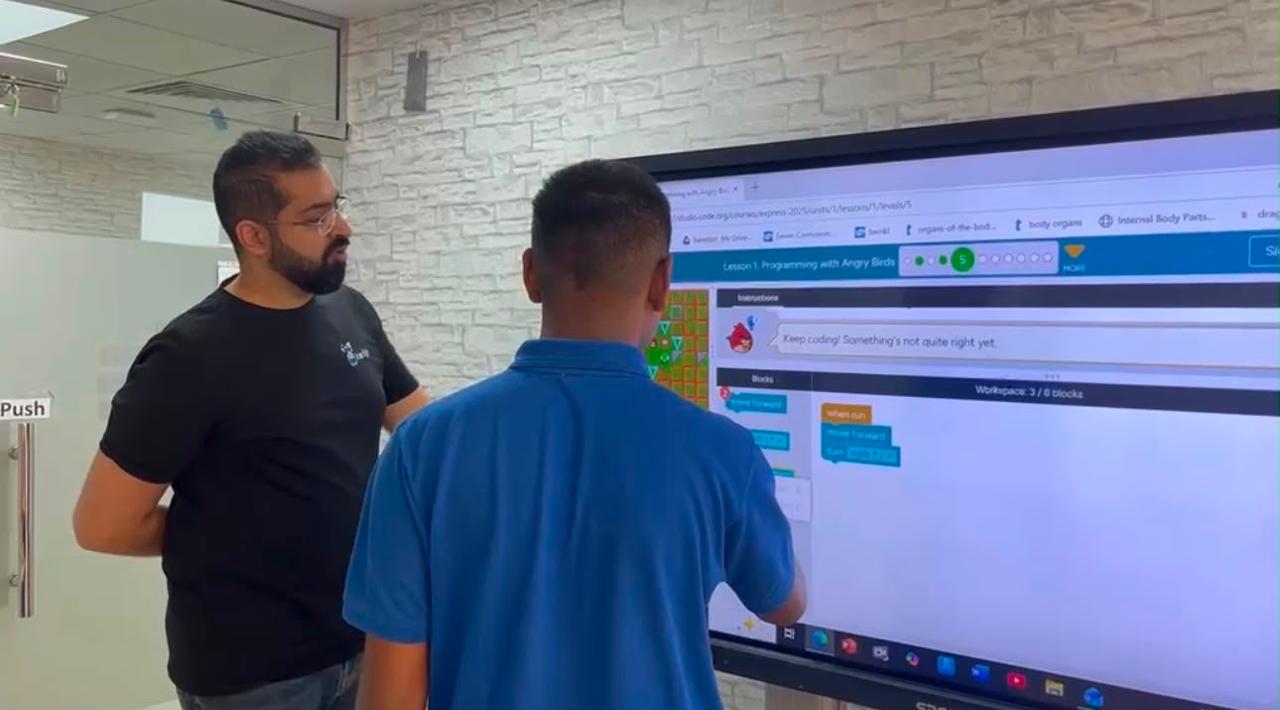
iCodejr, the STEM accredited, licensed online digital and AI literacy academy for school children, has completed a 10‑week paid coding enrichment program at Behaviour Enrichment, a leading pediatric therapy centre providing ABA therapy, Speech therapy, Occupational therapy and special educational programs for neurodivergent children and young people. The engagement, personally led by iCodejr Founder & CEO Hannan Moti, ran from April 23 to July 2, 2026 and supported 10 students across two age-differentiated batches.
The first batch, for learners aged 10–12, focused on introductory block-based coding using Scratch and Matatalab, with an emphasis on movement, loops, and early computational thinking. The second batch, for ages 14–16, built on this tangible, tools-based foundation to tackle more advanced Scratch projects, introducing greater complexity in logic, sequencing, and project design.
To ensure the program met the needs of Behaviour Enrichment’s community, iCodejr developed a custom-adapted curriculum specifically for autistic and neurodivergent learners, pairing visual, block-based coding tools with autism-informed teaching strategies and supports. The team also built a bespoke session feedback and engagement-tracking system, treating the accessibility adaptation as a genuine product build rather than a one-off intervention, and using real-time data to refine instruction week by week.
“Our mission has always been to make high-quality coding and STEM education inclusive, affordable, and accessible for every child—not just those who find it easy to fit traditional classrooms,” said Hannan Moti, Founder & CEO of iCodejr. “Partnering with Behaviour Enrichment allowed us to design around the strengths of autistic learners: their love of structure, focus on detail, and capacity for deep engagement. Coding becomes a superpower when we remove barriers and build with accessibility in mind.”
Rajashree Balasubramanian, COO of Behaviour Enrichment, said: “At Behaviour Enrichment, we believe that there are no limits to what students of determination can achieve. Over the past few years, we have been focussing on future skills through ICT programmes, covering Microsoft Office, design skills through Canva and more recently, using AI tools such as ChatGPT.”
Balasubramanian added, “Our partnership with iCodejr builds on this foundation by introducing coding into our ecosystem. This has added a structured and motivating learning channel that aligns beautifully with our therapeutic goals. We have seen the confidence that students gain as they bring their ideas to life through code, and the clear, predictable nature of block-based programming has been especially reassuring for many of our learners. The team at iCodejr has been wonderful to work with—highly skilled, patient, and encouraging. We look forward to seeing our students continue to build confidence, develop new skills, and soar to even greater heights.”
Global research increasingly shows that coding can be a powerful fit for autistic learners, who often thrive in logical, rule-based environments with clear cause-and-effect feedback. Studies and practitioner reports highlight that coding supports logical thinking, problem solving, spatial reasoning, and creativity, while offering predictable structure and immediate feedback that many autistic children find calming and engaging. Coding projects have also been shown to boost self-confidence, resilience, and social skills through collaborative work and shared problem-solving tasks.
Moti added, “Visual, block-based tools such as Scratch are increasingly examined as accessible platforms for children with cognitive impairments and autism spectrum conditions, because they minimize syntax barriers, rely on visual metaphors, and allow learners to build interactive media in a highly concrete way.”
The initiative reflects iCodejr’s broader thesis that coding education should be genuinely inclusive, not merely scaled, and that accessibility must be designed into products and curricula from the outset.
iCodejr’s work across the UAE and wider MENA region includes school partnerships, hackathons like Code Battle (the UAE’s largest inter-school coding competition), and impact initiatives such as Arab Kids Code, a non-profit program aiming to equip one million Arab students with high-quality STEM and coding education.
Following the success of the Behaviour Enrichment pilot, iCodejr plans to explore additional accessibility-focused engagements with schools, therapy centres, and non-profits, with a view to co-designing inclusive coding pathways that sit alongside ABA, Speech, and occupational therapy programs. The goal is to create a sustainable, data-informed model for accessible ed-tech that can be replicated across the UAE and beyond.